Insight
2025-12-22
Ignoring the cloud means abandoning AI! Is your company giving up on the future?

AI, is it okay to start with current infrastructure?
AI adoption is not simply about adding AI features.
A structure where data can flow seamlessly,
Infrastructure where AI can expand freely,
and design that minimizes potential risks must be implemented first.
In particular, for AI utilization, data should be in the cloud rather than on-premises to be utilized faster, and SaaS format is more effective than Local LLM. The cloud environment also provides a foundation for flexibly and effectively using various LLMs (Large Language Models).
In other words, the first step is to clearly define the optimal infrastructure environment that can stably implement AI and respond to future changes.
You must first verify whether the current system has the structure and environment to handle AI execution, and at this point, what must be checked is the infrastructure configuration and connection structure between systems, or 'structural diagnosis'.
The first barrier blocking AI is 'infrastructure'.
According to McKinsey, 70% of Fortune 500 companies still operate legacy systems over 20 years old,
which acts as a representative technical debt that hinders the agility and scalability needed for AI adoption.
In particular, generative AI-based IT modernization strategies have proven tangible results that can reduce work that previously took years to half the cost and shorten development speed by 40-50%.
However, for this innovation to become reality, clear prerequisites are necessary.
McKinsey specifies 'cloud transformation' as an irreversible essential condition for AI execution, and states that AI orchestration structures that organically connect and operate hundreds of generative AI agents cannot be implemented in on-premises environments.
The problem is that many companies are still discussing AI adoption without even recognizing whether they have technical debt.
If you do not accurately diagnose the core infrastructure conditions needed for AI execution, even if you move to the cloud, AI will inevitably stall.
※ Source: McKinsey, 'AI for IT modernization: Faster, cheaper, better', 2024.12.2
Infrastructure comparison for AI execution: Cloud vs On-premises
Where will you execute AI?
The choice between 「cloud or on-premises」 directly translates to competitive differences in scalability, flexibility, and data utilization.
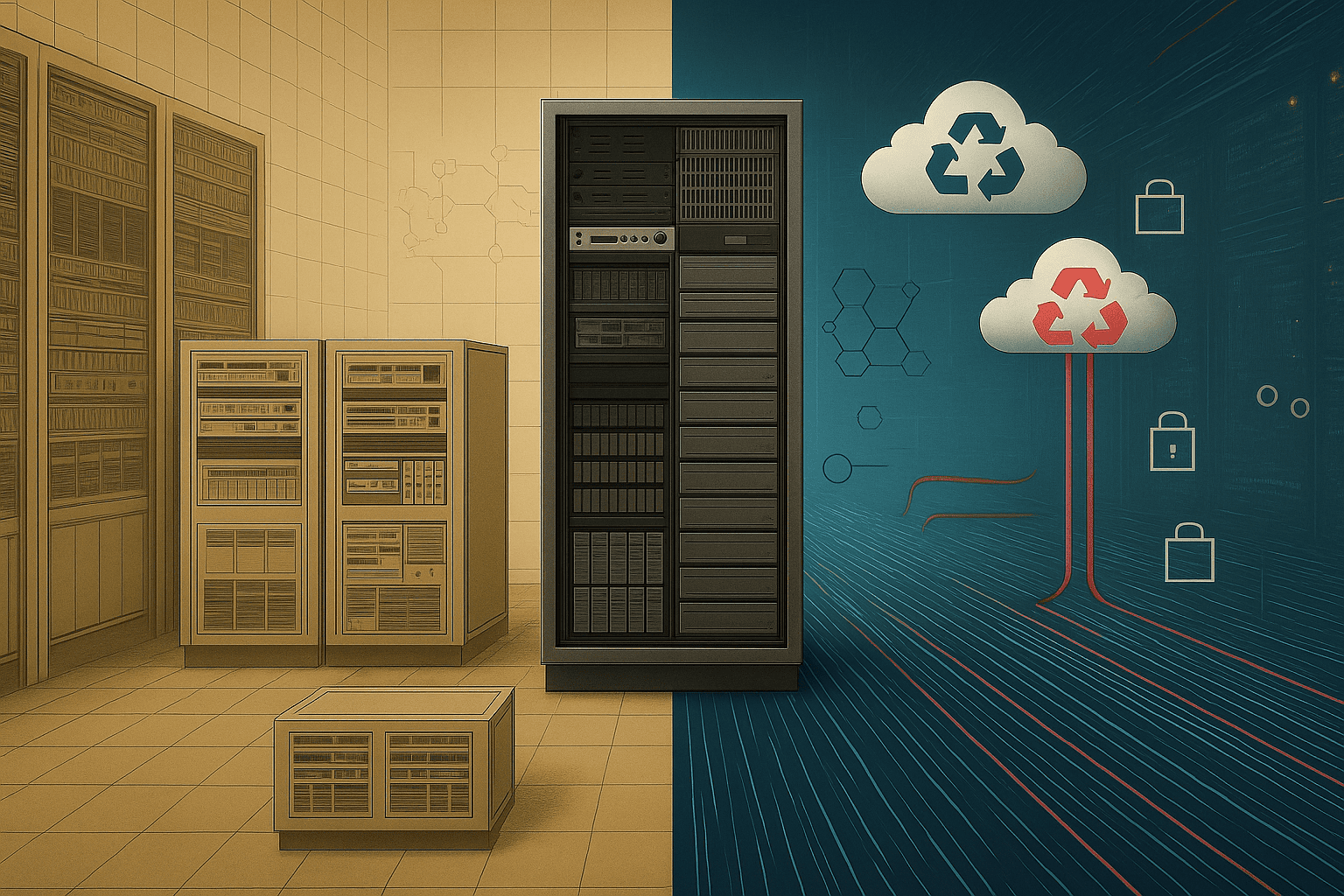
1️⃣ Scalability
On-premises requires weeks to months to expand GPUs or storage, but
the cloud can expand hundreds of computing environments in minutes with a single click.
In tasks like AI training that require large-scale resources, this speed difference directly translates to competitive advantage.
2️⃣ Flexibility
On-premises requires complex preliminary work for environment changes or new technology testing, but
the cloud can create test infrastructure in minutes and immediately remove it after experimentation,
dramatically shortening AI model experimentation and improvement cycles.
3️⃣ Data Utilization
AI cannot function properly without 「good data」.
On-premises has data scattered across departments and systems, making integration difficult, but
the cloud rapidly collects and integrates internal and external data to provide AI data-driven learning environments.
Ultimately, the starting point for AI infrastructure design should not be 「where to place servers」 but rather
which environment can execute AI faster and more flexibly.
The answer is the cloud.
Simple migration does not complete cloud transformation.
AI on the cloud cannot be built on 「unknown infrastructure」.
Successful leaps in the AI era begin with 「clear visualization of current systems」.
Many companies think cloud transformation is complete once they move to the cloud, but
most proceed with transformation without clearly understanding how current systems are interconnected, where data flows from, and what they depend on.
Simple listed information alone cannot design a cloud transformation strategy.
- Failure to identify system dependencies → Unexpected failures during transformation
- Data flow interruption → Business interruption and system integration errors
- Missing connection structures → Incorrect transformation priorities and schedule delays
- Idle and redundant assets left unaddressed → Cost waste and increased security risks
Hyper Mig: Strategic tool for 「connecting」 structures
Hyper Mig (Hyper Mig), which concentrates Megazone Cloud's cloud transformation experience and technical expertise, enables strategic transformation by comprehensively analyzing correlations between enterprise infrastructure, applications, and databases.
Beyond simple inventory collection, it generates foundational data for structural diagnosis and strategy establishment for cloud transformation, and
provides 「structured insights」 necessary for cloud strategy development.
- Collection without server, DB, app, network agents (Agentless)
- Visualization of dependencies between components (Dependency)
- Actual traffic-based structure map generation
- Identification of idle and redundant assets
Hyper Mig is the first step in stably creating the connection between AI and cloud.
AI strategy, successful migration is where it begins.
AI is not a 「feature」 but a 「strategy executed on an environment」.
However, many companies proceed with transformation after only identifying server counts,
experiencing unexpected failures and unnecessary cost losses.
Hyper Mig analyzes system context and flow to
provide strategic direction for the transformation journey toward AI infrastructure.
If you want to properly execute AI,
now is the time to think about the foundation with Hyper Mig.
📍 [Hyper Mig Series] Complete mastery of AI and cloud transformation
Episode 1: Ignoring the cloud means abandoning AI! Is your company giving up on the future?
Episode 2: Cloud transformation, AI infrastructure design… failure without understanding dependencies.
Episode 3: Now AI and cloud are executed with 'Hyper Mig'.
📧 Hyper Mig Inquiry: hyper_mig@megazone.com
🎬 Hyper Mig YouTube Channel: Go to link
✍️ by Shin Jeong-ran, Specialty Service Unit