Insight
2025-12-22
Essential Cloud Transition Methods to Know Before VMware Renewal
Introduction
Megazone Cloud is sharing technical insights through various seminars with AWS to help customers solve challenges in the rapidly changing IT infrastructure environment.
Recently, as VMware was acquired by Broadcom, significant changes are sweeping through the enterprise virtualization market.
Amid new subscription-based policies and increasingly complex cost structures, many companies are contemplating 「whether to maintain the current VMware environment or seek new alternatives」.
Megazone Cloud accepted this market change not as a simple technical issue but as a genuine customer concern.
According to a self-conducted survey (277 respondents, 207 companies) conducted before the seminar, the majority of respondents cited cost burden due to license policy changes and technology lock-in as major concerns. In particular, to the question 「If you consider VMware migration, when do you plan to start?」, approximately 60% of respondents answered 「I plan to start migration next year」.
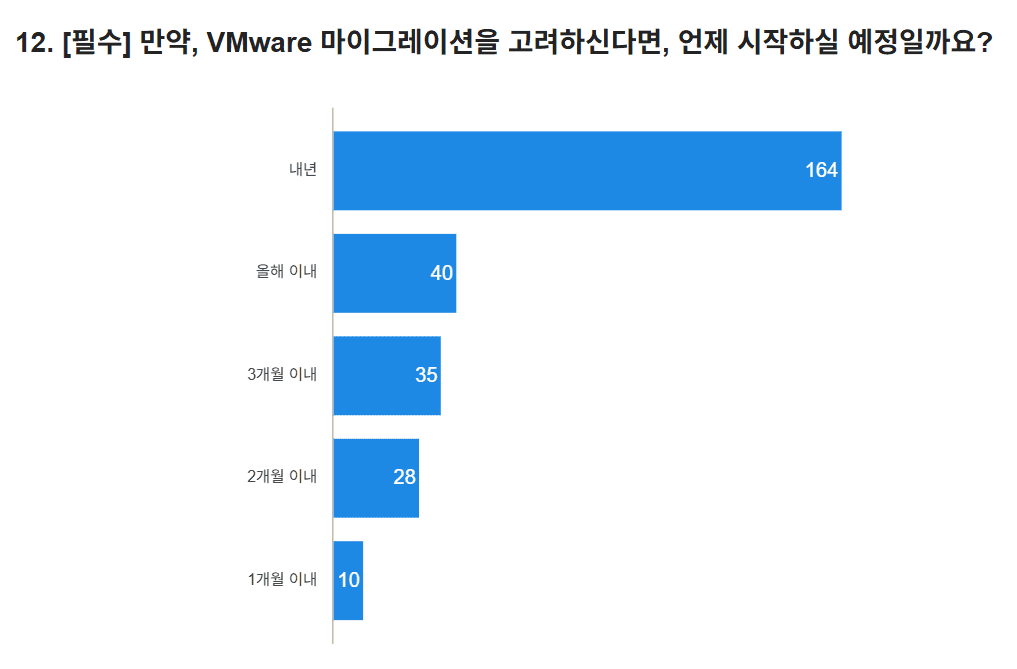
This result showed that while many companies recognize the need for change, there is a lack of guidance on where and how to start.
In response, Megazone Cloud prepared new VMware transition and modernization offerings based on actual customer needs, and prepared this seminar as the first step in that journey.
This seminar focused on practical strategies and case studies for expanding and transitioning VMware environments to AWS-based cloud-native structures. Now, let's check out the insights shared at the seminar venue! 🤓
Keynote
🎙️MegazoneCloud | Specialty Service Unit Chae Ki-tae
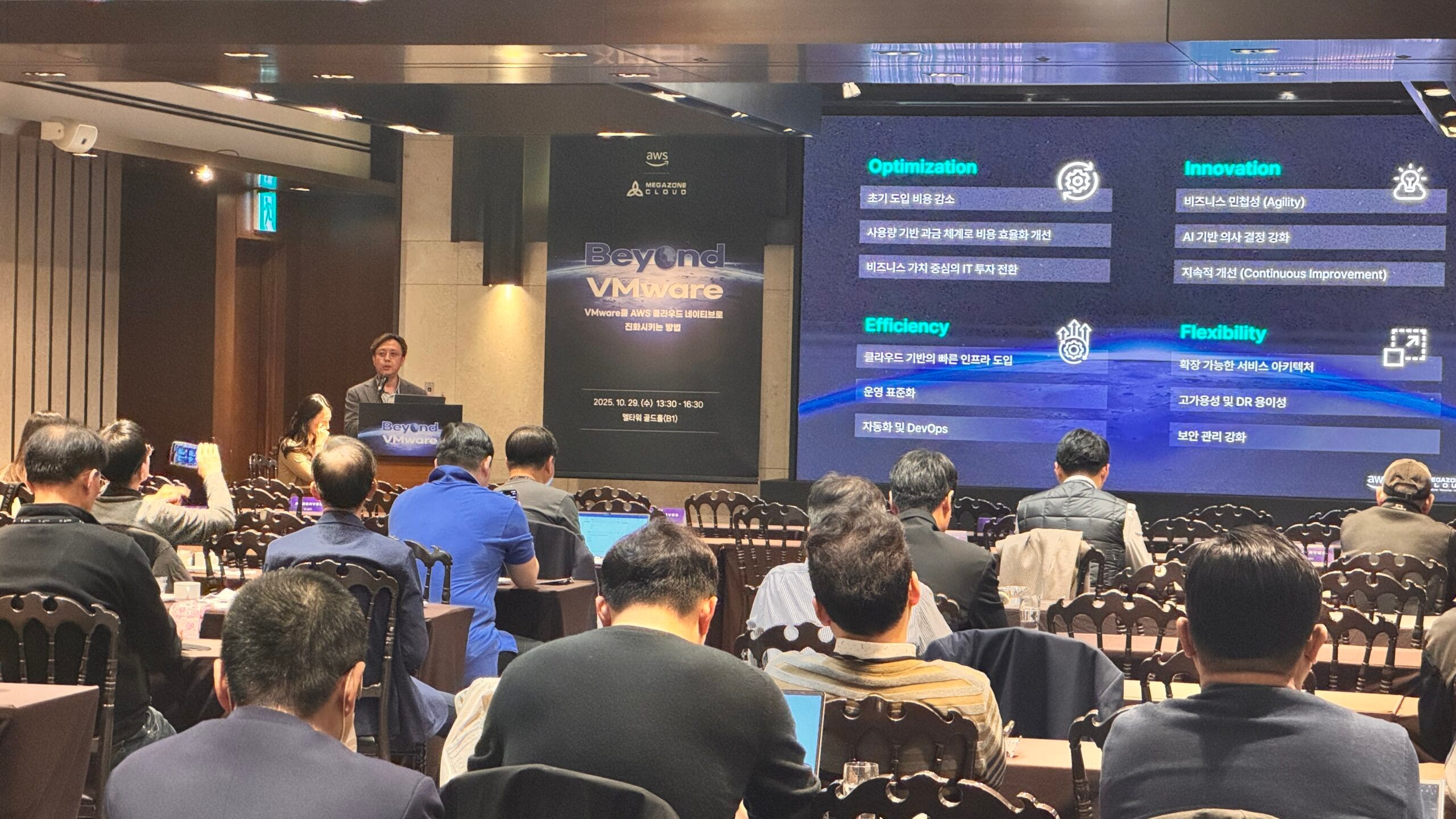
Megazone Cloud Unit Leader Chae Ki-tae presenting the keynote session
The keynote opening this seminar was led by Chae Ki-tae, leader of Megazone Cloud's SSU (Specialty Service Unit).
Based on his experience of over 2,200 days at Megazone Cloud working with numerous customers on cloud transition and modernization strategies, Chae Ki-tae posed the question 「How agile and flexible is our current IT infrastructure?」 to begin the session.
While many companies are currently contemplating cost reduction, efficiency, and sustainable operational structures amid uncertainty, he pointed out that the high initial investment costs, scalability limitations, and complex maintenance structures experienced in VMware environments are now issues affecting overall business competitiveness.
Based on this, he introduced four key values when transitioning VMware environments to AWS.
- Optimization: Maximizing IT investment efficiency through pay-as-you-go pricing structure
- Innovation: Building infrastructure in just hours and enabling rapid business response through AI-based decision-making
- Efficiency: Improving operational standardization and productivity through automation and DevOps
- Flexibility: Scalable structure for traffic spikes and disaster response based on high availability
- Additionally, referencing the Kakao data center fire incident, he emphasized 「Now, failures are not merely system problems but business continuity itself」.
Finally, he presented VMware to AWS transition as two journeys: one is 「VMware to AWS Pathway」 that moves the existing environment with minimal changes, and the other is 「Amazon Transform for VMware」 strategy that enhances operations through AI and automation.
He defined this as a process of 「evolution」 rather than simple 「migration」, concluding the presentation.
Through this keynote, participants gained deep insights into how future infrastructure will determine business speed and resilience, beyond simple technology selection.
Successful VMware Transition Through AWS: Introduction to VMware to AWS Pathway
🎙️AWS | Infrastructure Modernization Specialist Kim Kang-il
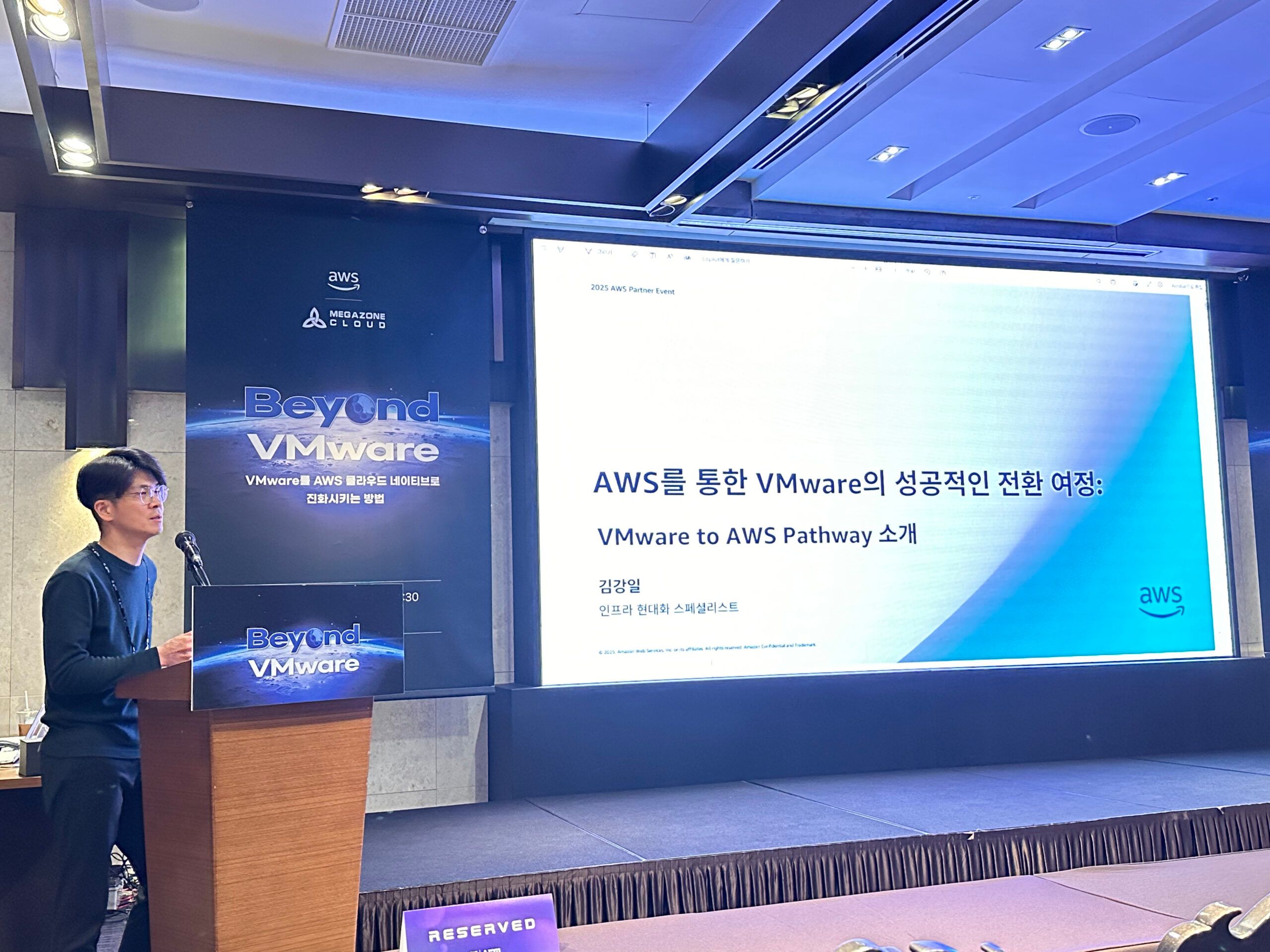
AWS Infrastructure Modernization Specialist Kim Kang-il presenting on successful VMware transition through AWS
Next, AWS Infrastructure Modernization Specialist Kim Kang-il presented on the specific pathways and methodologies for transitioning VMware environments to AWS.
Kim Kang-il first addressed the practical burden brought by VMware's license policy changes following the Broadcom acquisition.
The structure that previously allowed purchasing only necessary features has now shifted to integrated packages and subscription-based models, with virtual machine execution costs potentially rising up to 12 times, he pointed out.
As a result, approximately 74% of VMware customers are exploring new alternatives, with AWS at the center of this trend, he emphasized.
AWS was introduced as the most reasonable transition platform with over 18 years of operational experience, 37 regions of global coverage, over 300 security features, and over 200 service offerings.
It supports soft landing through various options to run VMware workloads directly in the cloud or gradually expand from on-premises environments.
He emphasized that cloud migration is important not just as simple system transfer but as selecting the optimal migration path tailored to each company's workload characteristics and business goals, presenting 「VMware to AWS Pathway」 for this customized approach. This provides a comprehensive migration path consisting of five stages—Relocate, Rehost, Replatform, Refactor, and others—along with virtualization services from AWS strategic partners, enabling design of optimal cloud transition.
The key solution in this process is Amazon EVS (Elastic VMware Service).
EVS runs VMware Cloud Foundation directly on EC2 bare metal instances within AWS, enabling easy operation of the same VMware environment as on-premises on AWS.
Through automatic provisioning, full administrator access, and flexible billing models, it is recognized as the fastest and safest migration path.
Finally, Kim Kang-il noted that using AWS services such as AWS Transform for VMware and AWS Application Migration Service (MGN), along with diverse ISV tool ecosystems like Cloudamize, CAST, and CloudHedge, can realize migration automation, cost optimization, and security enhancement.
This session was significant in that it presented not just 「how to move VMware」 but 「why AWS should be chosen now」 with clear evidence, along with a practical roadmap enabling enterprises to secure both innovation and efficiency in cloud-native environments.
Faster and Easier VMware Migration Using AI: Introduction to Amazon Transform for VMware
🎙️AWS | Migration Partner Solutions Architect Kang Hong-seok
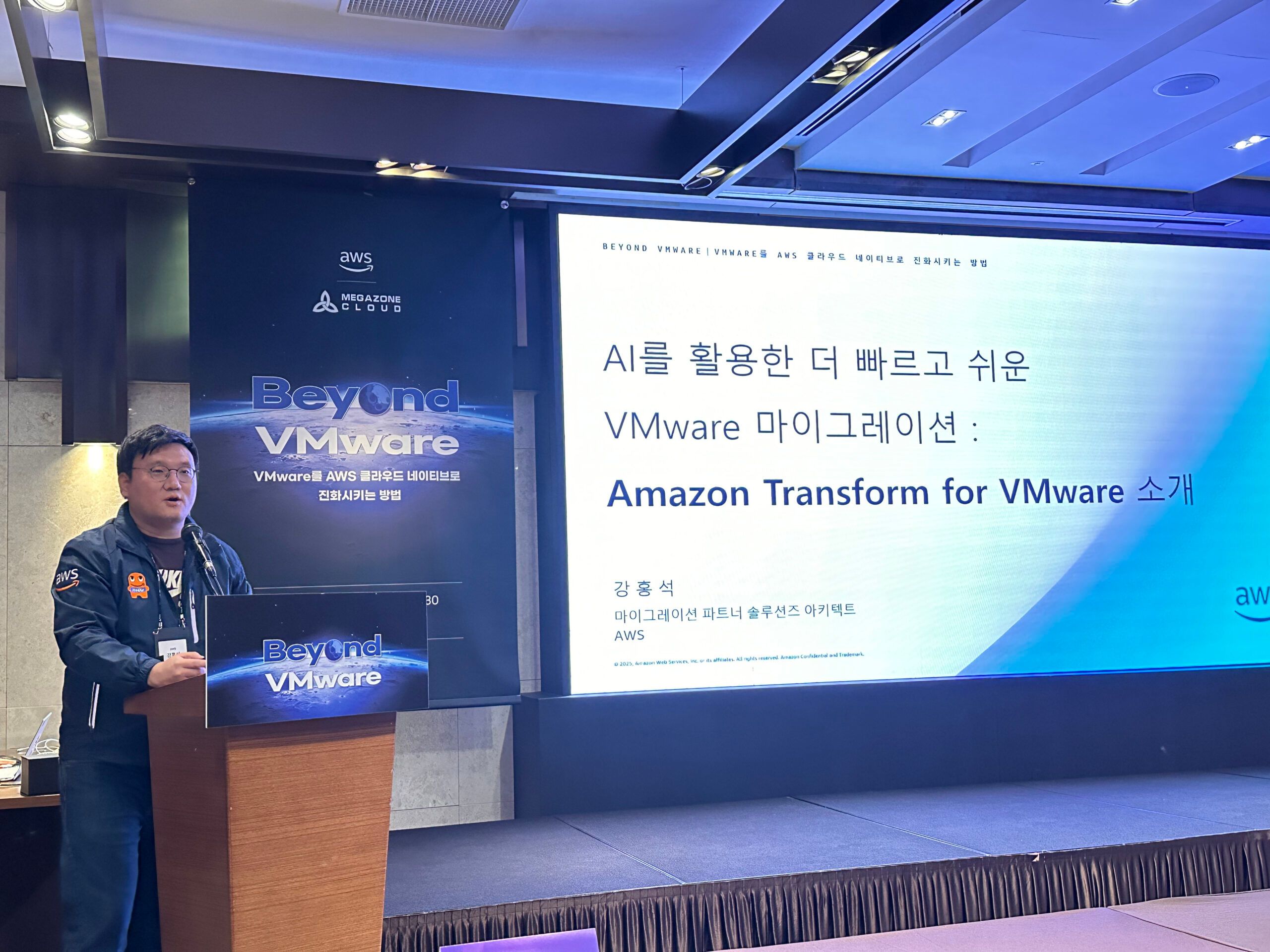
AWS Migration Partner Solutions Architect Kang Hong-seok presenting on faster and easier VMware migration using AI
The next session was led by AWS Migration Partner Solutions Architect Kang Hong-seok, introducing how to rapidly and efficiently transition VMware environments to AWS cloud-native through AI-based automation.
The session began with the practical difficulties faced by customers operating hundreds to thousands of virtual machines (VMs) in existing VMware environments.
Outdated infrastructure, complex network configurations, firewall policy migration, and collaboration burdens between multiple teams inevitably made large-scale migration projects time-consuming and resource-intensive.
The solution to address this is 「AWS Transform for VMware」.
This service is an Agentic AI-based automation service officially launched by AWS in May 2025, with its core being to analyze existing VMware environments, establish optimal migration plans, and automate the actual transition process step by step.
The AI agent first collects inventory information from VMware vSphere and NSX environments in the Discovery stage, and based on this, AI automatically generates Wave plans to group which VMs to move first.
In the next Network Transformation stage, existing NSX firewall rules, subnets, and routing information are automatically mapped to AWS Security Groups, NACLs, and VPC structures to automatically configure the new environment.
This process doesn't require people to write transformation scripts directly, and AI-generated Infrastructure as Code (IaC) templates in CloudFormation or CDK format are automatically deployed. At each critical stage, people can review whether it was applied correctly before proceeding to the next step, configured in a 「Human-in-the-loop」 format, enabling stable migration project progression in the desired direction.
In the final stage, it connects with AWS Application Migration Service (MGN) to actually move VMs to the AWS environment (rehost) and automate replication, testing, and cutover.
All these processes can be monitored in real-time through the AWS Transform dedicated dashboard, allowing you to check progress, errors, and resource status at a glance.
Additionally, Kang Hong-seok emphasized that compared to existing VMware NSX-like network and security configurations, AWS environments enable complete automation of security, governance, compliance, and operational efficiency based on the security lifecycle framework (identify-protect-detect-respond-recover).
In other words, transitioning to AWS means not just moving infrastructure but redesigning the entire operational, security, and management processes into an automated cloud-native environment.
VMware to AWS transition is now an era of modernization where AI agents automatically perform planning, analysis, transformation, and deployment, rather than projects where people manually write scripts. Through this, enterprises can reduce the complexity of large-scale VM migration, optimize costs and workforce, and organically connect AWS native services and AI capabilities to evolve into more agile and secure digital infrastructure.
Migration for Hyper Mig: The Most Reliable Migration Journey Success Strategy
🎙️MegazoneCloud | Specialty Service Unit Park Min-seok
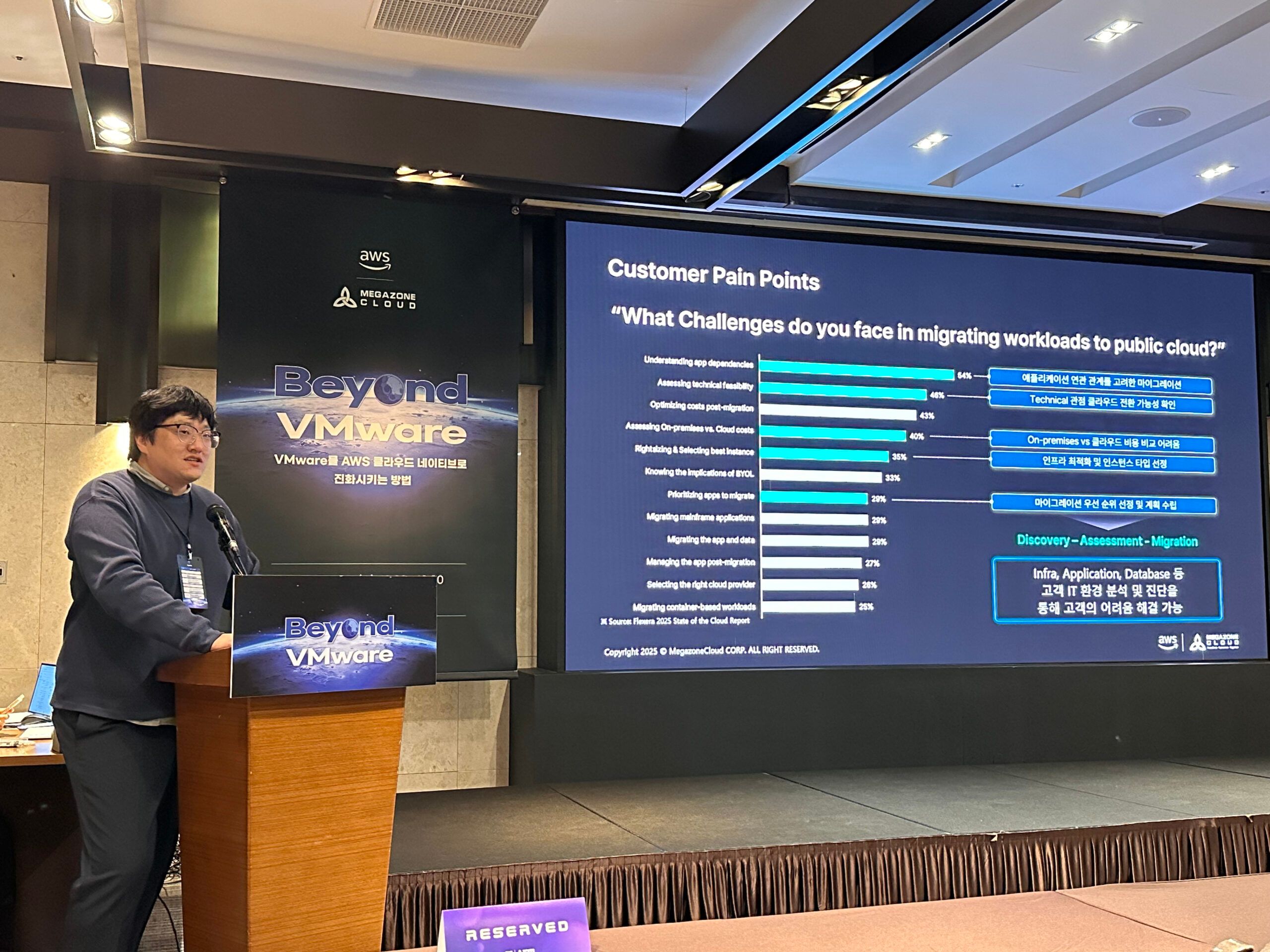
Megazone Cloud Unit Leader Park Min-seok presenting on Migration for Hyper Mig
The final session was led by Megazone Cloud SSU Park Min-seok, introducing strategies for more efficiently executing complex migration projects centered on the 「Hyper Mig」 solution.
Park Min-seok first pointed out limitations of existing approaches through actual customer cases.
In one project, over 50 people were deployed for approximately 4 months to collect inventory and manually verify server utilization and connection relationships, but problems of low data accuracy and varying analysis results by person were repeated.
Additionally, it was difficult to analyze applications and databases comprehensively, requiring significant time for migration target selection and effort estimation.
To solve these problems, Megazone Cloud developed 「Hyper Mig」.
Hyper Mig is a platform that automatically 「discovers」 customer resources, comprehensively 「assesses」 relationships between infrastructure-applications-databases, and manages migration progress by project through a 「dashboard」.
In the 「Discovery」 stage, resource collection is automated based on inventory provided by customers, and even unidentified resources (Unknown Hosts) communicating on the network are detected. Through this, customers can newly identify systems or assets they were previously unaware of.
In the 「Assessment」 stage, infrastructure and databases are mapped centered on applications, visually showing their relationships and interface structures. Through this process, analysis and documentation that were repeated manually are greatly reduced, and diagnostic accuracy and reusability are enhanced.
In the 「Migration」 stage, migration targets and efforts by phase are defined, and progress can be checked in real-time through the dashboard. Project schedules, deployed personnel, and status by execution phase can be grasped at a glance, enabling both PM and operations teams to manage migration by the same standards.
Park Min-seok emphasized that through Hyper Mig, the time required for understanding complex system status and initial diagnosis is greatly shortened, and migration validity can be quickly secured. He added that Hyper Mig provides 「practical basis for enterprise governance reestablishment」 and 「cloud transition decision-making」.
Hyper Mig received recognition for this innovation by winning the 「2025 Korea ImpaCT-ech Award」. The cases demonstrating not only technological excellence but also reduced operational risks in actual customer environments and dramatically shortened cloud transition periods were highly evaluated.
This session presented concrete answers centered on Hyper Mig's automation capabilities on how to reduce the complexity of migration journeys and increase success probability.
Conclusion
This Beyond VMware seminar was an opportunity to share answers on why enterprises should consider cloud transition now, beyond simple technology transfer.
As mentioned in the sessions, traditional migration was a complex process taking several months and requiring dozens of people. With inefficient methods like manual inventory and team-by-team verification, application-database relationship documentation, it was difficult to secure both speed and accuracy simultaneously.
Now, cloud has become not a choice but the foundation of business agility and competitiveness. Efficient transition through AI and automation, data-driven decision-making, and stable and flexible operational systems are at its core.
Megazone Cloud supports enterprises in rapidly and accurately moving complex infrastructure to the cloud through VMware to AWS transition journeys and innovative solutions like Hyper Mig.
We hope this seminar served as an opportunity to convey practical insights and direction to all those preparing for cloud transition, and we look forward to the next seminar!
📑Hyper Mig Introduction Brochure
Written by │ Megazone Cloud Marketing Unit Manager Lee Yu-min