Interview
2025-01-06
Center Director Gong Seong-bae: "Proven ZenAI 360 Technology, Securing AI Leadership Beyond MSP"
In the era of digital transformation, as companies accelerate cloud adoption, the MSP (cloud service provider) market is experiencing rapid growth. However, the market has recently reached a new inflection point. Business innovation using artificial intelligence (AI) and data has emerged as a key topic, going beyond simply providing cloud infrastructure.
Since its establishment in 2018, Megazone Cloud has recognized the importance of AI and data and has consistently accumulated related capabilities. Last year alone, it completed 26 generative AI projects and created 16 actual implementation cases. The company also achieved the distinction of being selected as the only Korean partner in AWS's Partner Innovation Alliance.
Megazone Cloud is now presenting a new vision of 'becoming a leading company in AI transformation beyond MSP.' This is supported by differentiated implementation cases such as Hana Tour's AI chatbot, hy's e-commerce platform, and Hansol Paper's AI sales log. We met with Gong Seong-bae, Director of Megazone Cloud's AI&Data Analytics Center, who is leading these changes, to hear about the company's innovation strategy and future vision.
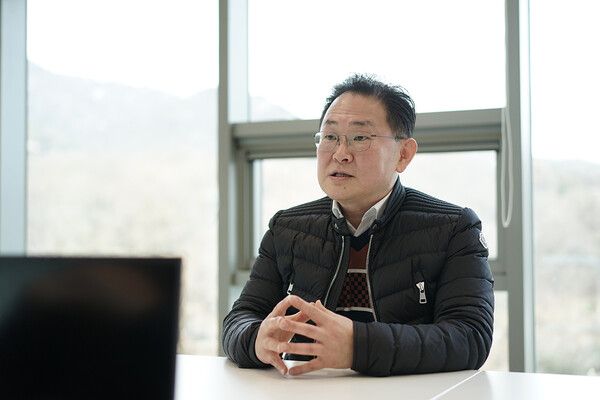
― I'm curious about Megazone Cloud's AI business journey.
"From the time of spinoff in May 2018, Megazone Cloud set AI and data as core growth drivers. While the MSP business received attention, it was relatively less known, but we began full-scale AI and data business from 2019. To date, we have successfully completed over 150 projects. In particular, 2024 was a meaningful turning point for us. We conducted 26 generative AI projects and derived 16 production cases. This was an achievement that went beyond simple proof of concept (PoC) to create actual business value."
― I understand GenAI 360 is Megazone Cloud's representative AI service. What are the characteristics and differentiators of this service?
"GenAI 360 is an end-to-end service composed of five key elements. First, strategic consulting for companies' generative AI utilization. Through the GenAI 360 Digital Studio, we establish companies' generative AI utilization strategies and perform model expansion and validation based on corporate data. Rather than blindly adopting generative AI as a trend, we clarify companies' requirements through approximately one month of consulting and check their data readiness.
Second, providing a generative AI platform. We provide customized generative AI solutions that are integrated and managed on a single platform. The recently launched 'GenAI 360 Platform' is optimized for companies' environments, allowing users and administrators to work in an integrated environment.
Third, establishing an implementation roadmap. We support systematic adoption through a 4-week pilot project and phased expansion of applicable business areas. This is a strategic approach that enables companies to adopt generative AI gradually and stably.
Fourth, we provide professional training programs. Through expert courses for IT administrators such as generative AI implementation and operation, we support companies' internalization. Through this, companies can secure their own AI operation capabilities.
Fifth, operation services. We support dedicated organizations for companies' generative AI operations and provide generative AI operation through professional organizations. If customers wish, we ensure stable service operation through continuous operational support."
― Please explain GenAI 360's application method and results through actual implementation cases.
I'll explain three representative projects recently completed. First, there's the case of building an AI chatbot service for Hana Tour. The characteristic of this project is that it implemented a customized consultation service linked to customers' actual reservation information, not just a simple FAQ bot.
For example, when inquiring about flight ticket refunds, instead of general guidance, we immediately provide the specific refund amount for that customer's flight ticket. For this, we utilized Anthropic's Claude 3 model based on AWS's Amazon Bedrock, and built a system that links reservation information and consultation history in real-time through retrieval-augmented generation (RAG) technology.
Second, there's the hy online mall 'Fredit' search system enhancement project. Fredit, which has 1.8 million members, previously only provided simple keyword search, but by applying generative AI technology, we enabled natural language search. It provides accurate search results even with everyday expressions like "Recommend a gift for Parents' Day" and AI analyzes search intent to provide contextualized explanations.
Third, there's the Hansol Paper AI sales log implementation case. By analyzing unstructured sales log data accumulated over 10 years using RAG technology, necessary insights can now be extracted immediately through natural language queries. In particular, when personnel changes occur, new managers can quickly understand work history, greatly improving business continuity.
― What is Megazone Cloud's differentiated competitiveness?
"I can point to three things. First is speed. We typically complete AI projects that take over 8 weeks in about 4 weeks. As a real example, in a manufacturing company project, while a competitor handled one task in 8 weeks, we completed two additional tasks with superior quality in 3 weeks.
Second is quality. Since we started from the data business, we are particularly sensitive to data quality and reliability. We have invested heavily in RAG technology advancement to minimize the hallucination problem of generative AI.
Third is the all-in-one approach. We are not dependent on any specific cloud platform and provide solutions optimized for customers' environments. Our strength is the ability to flexibly utilize various platforms such as AWS, MS Azure, and Google Cloud."
― What are your activities and strategies in the global market?
"Currently, we are developing AI and data business centered on Hong Kong, Vietnam, and North America. In Japan, we have stably entered the market through a joint venture with Itochu Techno Solutions (CTC). We are particularly paying attention to the Southeast Asian market. This region lacks strong MSP companies, so there are many opportunities. We are planning to expand from Vietnam to Malaysia, Thailand, and other countries.
However, a careful approach considering each country's regulatory environment and business practices is necessary. Localization strategy is also important. For example, our Hong Kong office is operated mainly by local employees to increase market adaptability."
― I'm curious about your future strategy and vision.
"Our goal for 2025 is to solidify our position as a leading MSP and AX (AI transformation) company.
In particular, we are pursuing full-scale expansion into the large enterprise market. The market environment also supports this strategy. Large enterprises, which traditionally procured IT services through their own SI organizations or group affiliates, are now actively embracing external expertise in adopting new technologies like generative AI. Being selected as the only Korean partner in AWS's Partner Innovation Alliance is an important indicator proving our technological capabilities and market expansion potential.
Megazone Cloud plans to strengthen investments in two directions to lead these market changes. One is service enhancement for enterprise-level customers. We will further strengthen our capabilities to meet the demanding requirements of large enterprises such as large-scale system integration, data governance, and security. The other is developing industry-specific solutions. We are preparing customized AI solutions that reflect the characteristics of each industry such as manufacturing, finance, and retail.
The generative AI market is still a blue ocean with no absolute leader. We will establish a new identity as a leading AI transformation company on top of our stable growth foundation as an MSP. In particular, our ultimate goal is to prove our competitiveness in the global market beyond Korea based on successful cases in the large enterprise market."
Article Source: IT Chosun