Interview
2025-06-16
Kim Dong-ho, Vice President of MegazoneCloud, "Quantum will become the 'infrastructure of infrastructure' that can support the computational infrastructure for AI!"
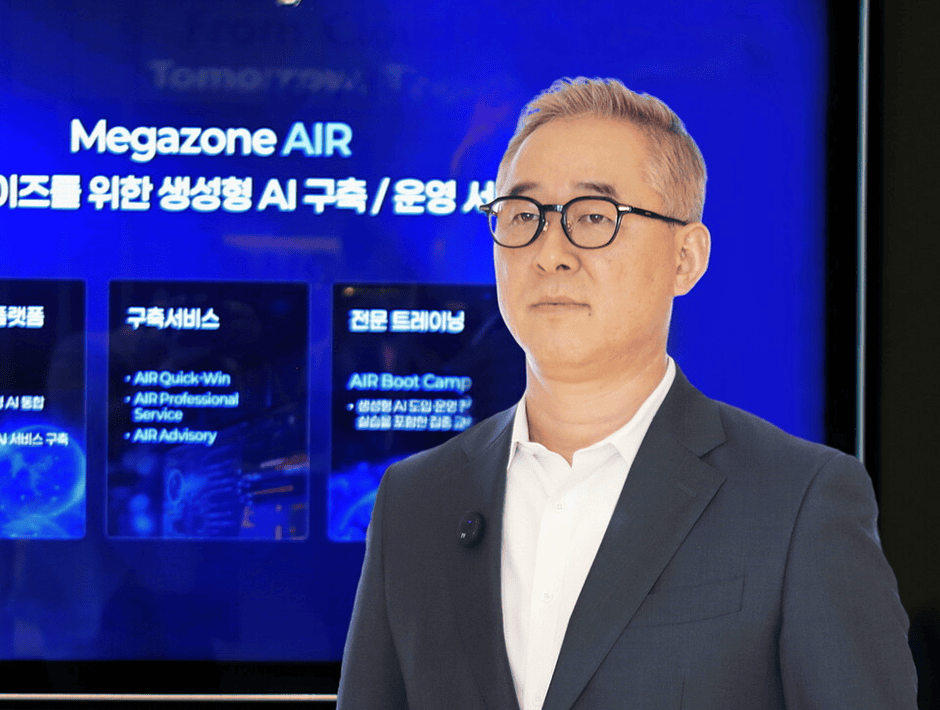
A technologist's career that began in chip design has expanded over time through long years of hands-on experience with technology and direct experience of its limitations, to now encompassing a perspective that views the entire industry. It was a journey of not merely developing or testing technology, but constantly contemplating where and how it could actually be used.
Vice President Kim Dong-ho of Megazone Cloud is a person who has experienced decades of computing technology advancement in the field through a journey spanning LG Electronics, Silicon Valley in the United States, and back to Korea.
From the moment he designed a single chip, he contemplated the direction of the industry, and was among the first to sense the practical reality that «a new method of calculation is now necessary» amid increasingly complex computational demands and system limitations. He was the first to experience the point where existing technology reached its limits, and chose quantum computing as an alternative. However, his interest did not stop at simple technology implementation. This was because he had a clear standard: «technology must work.» He valued more than visible equipment or code how that technology would function in the market and what problems it would solve. Under the belief that technology must work in actual industry, he prepared the stage one by one to create «technology that can work.»
His career began as a research and development personnel fulfilling military service at LG Electronics. Majoring in signal processing in graduate school, he was assigned to a cutting-edge HDTV prototype development project at the time. In an era when analog and digital coexisted, the experience of learning the complexity of signal refinement and representation technology through practice determined his subsequent path.
"It was just fun back then. I enjoyed making something and seeing it actually work." He recalled that period when his identity as a technologist truly began. Subsequently, pursuing his curiosity as a researcher, he studied abroad at the University of Texas at Austin (UT Austin), where he earned a Ph.D. in computer science. His major was chip design.
In the United States, he worked for about 9 years as a practitioner designing various semiconductor chips in collaboration with Intel and others. Within complex circuit structures connected by hundreds of nodes and transistors, he contemplated how to compute faster and process with less energy. "Every time I designed a chip, I ultimately had to think about the structure of the entire system. It wasn't simply about being fast; the issue was whether it operated efficiently."
He later returned to Korea and rejoined LG Electronics, participating in various chip development projects including CPUs, GPUs, smartphone APs, and AI-specialized chips. At that time, he even experienced structure design specialized for artificial intelligence computation, growing beyond a simple design engineer into a technologist and planner who understood and improved the overall operation of the entire system. It was a point when his perspective began to expand beyond a single chip to see the entire platform.
However, he was also the first to experience the limits of technology. "Chips ultimately keep moving toward finer processes, but at some point, this can't be solved anymore." As a chip designer, he witnessed power issues, heat problems, and process limitations before anyone else. Computational performance was increasing, but power and energy efficiency were stagnating. "Calculations were becoming increasingly complex, data was pouring in, and it became recognized within the company that silicon couldn't handle this."
He recalls that problems that couldn't be solved with existing technology began to become clearly visible. As AI computation increased and systems became more complex, situations arose where existing chips were difficult to handle. "There are issues like the complexity of calculation, or what you might call the curse of dimensionality. When nodes number in the hundreds or thousands, it's not simple connection but complexity of a different dimension. The limitations of the existing approach were too clear."
Under this recognition, he first shared within his team the awareness that a new method of computation was necessary, and eventually the keyword quantum computing emerged. At first, even colleagues hesitated, saying «this isn't a problem we can handle,» but he didn't give up and pushed through to the end. This is how the quantum TF within LG Electronics began, later leading to a formal quantum computing team under the AI Research Institute.
He wasn't certain from the beginning that quantum was the answer. However, he had a clear intuition that at least the only possibility to transcend current limitations lay there. Thus he gained conviction that a new method of calculation and a new computational system were necessary, and subsequently began earnest exploration and experimentation in quantum computing.
When the word quantum first appeared, Vice President Kim Dong-ho admitted he was honestly bewildered. "Back then, it was a technology only physicists knew about, and it felt like something that would only appear in science fiction movies." In fact, when LG invited a Japanese consultant to hold a seminar on quantum computing, he recalled that among about 20 attendees, almost no one understood due to the English presentation and unfamiliar concepts. "They were people who had worked in algorithms for over 20 years, but no one understood."
However, he felt interest in this unfamiliar technology. Though initially unfamiliar, he gradually began to pay attention to the possibility as he recognized the fundamental difference in computational methods that quantum computing possessed and the completely different concepts from existing computing, which transformed into conviction that it was «the ultimate computing capability humanity can currently conceive.» Ultimately, he pursued this topic to the end, creating a formal TF within the team and leading to the establishment of a formal quantum computing organization under the Artificial Intelligence Research Institute.
Subsequently, even after moving to POSCO Holdings, he similarly composed a quantum R&D team directly. Creating a new organization was not something that could be done by simply knowing technology. Internal persuasion, problem discovery, talent composition, and technology goal setting all had to be restructured from scratch. He recalled, «I started almost alone back then. There was no team, and there was a complete absence of related personnel.» Nevertheless, he did not give up. Unlike existing technologists, his perspective on problems was different.
"There are problems that can't be solved with existing technology. Finding that first is the starting point. You can only build a team when you grasp the problem, and that's where technology gains meaning." He designed the team around problems and designed technology around that team. Problem-centered rather than technology-centered technology management. This was also a transition from a technologist's thinking to a designer's thinking.
From then on, he began to redefine himself not as someone who handles technology, but as someone who designs the structure and conditions in which technology is handled, and the problem definition itself. From technologist to strategist, from executor to planner—it was a turning point where the trajectory of the name Kim Dong-ho clearly changed.
After joining Megazone Cloud, he began connecting his accumulated technical experience to actual market services. Rather than simply providing qubit computation, he packaged quantum technology in a form that could solve actual problems faced by companies. He said, «If you just provide computing, it's actually like a bun without red bean filling. You need a solution attached to solve problems."
He didn't want to remain simply as «a company with quantum technology.» «Anyone can run calculations. But what customers really want is what they can do with that calculation. What good is it if computation speed is just fast? You need to be able to reduce risk, optimize processes, or solve real-world problems with it." In fact, he is taking an approach to existing cloud service customers of «let me first tell you what calculations your company actually needs now» rather than simple technology explanation.
This approach also means becoming a practical partner rather than a simple technology supplier. «Technology is ultimately about working, right? And for it to work, it needs to be structured around problems, not just technology.» He said that even now, whenever he meets a new customer, he asks «what problems do you have?» before introducing technology.
Megazone pursues quantum cloud services applicable directly to industry, not simple technology demonstrations. Rather than simply saying you have technology, it's important to prove whether that technology actually leads to contracts, services, and revenue. Vice President Kim said, «In our country, there are several companies with quantum technology, but there are almost no companies generating substantial revenue through quantum cloud. However, we are achieving that.»
Currently, Megazone is providing quantum cloud services under formal contracts with 6 domestic companies and 2 Japanese institutions, and actual revenue is being generated through these projects. Vice President Kim emphasizes that this result is not merely about technology possession, but a real indicator proving that «technology works in the market.» «Technology must speak in the market, not in the laboratory. Real technology is revealed when you actually run it.» Vice President Kim emphasizes that this approach is how technology «works» in the market.
Since Megazone Cloud operates in various technology domains, Vice President Kim Dong-ho says it's difficult for him to directly understand all solutions. He explained, «Honestly, the technology fields Megazone handles are too diverse. Cloud alone involves multi, hybrid, AI, and security all intertwined, with dozens of services running in each area.»
For example, he drew a line that recent achievements such as Megazone acquiring Snowflake's «Elite Partner» status, one of only 10 companies in the Asia-Pacific region, or being selected as «Outstanding Ambassador» at «SusHi Tech» held in Tokyo, are not areas he directly involved in. «I can't know all of that. I learn about it later. The PR team knows better,» he added with a laugh.
Particularly noteworthy is collaboration with Seoul National University. Based on quantum emulator technology developed by an internal research team at Seoul National University, together with spinoff company «QubiStack» (formerly Quents), Megazone Cloud successfully conducted high-performance emulator experiments at the 42-qubit level. This is an achievement with almost no precedent in existing commercial cloud environments, and the experiment operated smoothly on AWS, receiving significant attention. Vice President Kim described this as «global top-level for quantum emulators,» and evaluated that this technology could serve as a practical bridgehead connecting research and industry.
He cited accuracy and cost as the strengths of quantum emulators. «Real quantum computers are still expensive and have fidelity issues. But this has accuracy of 1 and is much cheaper.» In fact, he emphasized that this technology is optimized for algorithm and application development, and is «the most practical choice for companies wanting to use quantum right now.» Collaboration with Quents is not limited to pilot testing but is pursuing full-scale productization with commercialization possibilities open. Vice President Kim said, «Industrialization happens when you can continuously use the computational environment. In that sense, this is really technology that creates the stage.»
He does not view AI and quantum separately. Rather, he says quantum becomes increasingly necessary as AI grows. «AI is now inseparable from our daily lives. But the computational infrastructure that can support that AI will become even more important going forward. I believe quantum will become the «infrastructure of infrastructure.»»
Ultra-large AI models show exponential increases in computation and energy consumption, and he cited data centers in the United States as an example, saying «now people even say you need to build a power plant to run one AI.» Particularly recently, as models needed for AI learning or inference have become too large, securing power infrastructure has become a bigger challenge than technology itself.
He views quantum computing as a solution that can directly address these problems. Because the computational power increases exponentially each time the number of qubits increases within the same equipment scale, it's possible to simultaneously secure processing speeds and energy efficiency unimaginable with traditional systems. He added, «In an era where we run AI while worrying about power like now, quantum computing might be not a choice but a necessity.»
Ultimately, his perspective is that quantum cannot help but become core technology constituting the foundation of the entire industry beyond being merely infrastructure supporting AI. Like the analogy «if AI is the surface of industry, quantum is the underground foundation supporting that surface,» he views the two technologies in a vertical rather than parallel relationship. He judges based on whether technology can actually «work,» that is, whether a sustainable computational environment is possible in actual industrial settings, rather than the technology itself.
He cited finance, process optimization, and simulation as actual industrial examples where AI and quantum are used together, and revealed that he is intensively analyzing the intersection points where these two technologies mesh. «In cases like financial risk prediction, the amount of calculation is enormous and real-time response is important. Quantum is a representative field where it can actually prove performance here.» He also believes that AI and quantum can naturally combine in areas requiring complex numerical calculations such as process optimization in manufacturing and logistics, and urban traffic simulation.
«If existing AI simply made predictions, with quantum attached, you can handle faster and more complex calculations in real time. It's a different approach, but ultimately it's a way of dealing with one problem three-dimensionally.» He explained that role division is possible where AI reads the surface and quantum calculates the structure within in actual industrial settings.
Vice President Kim Dong-ho says the real beginning of quantum technology is now. In the past, even with technology, there was no stage for it to work, and the environment for experimentation was limited. «Before, we had technology, but there was no stage where we could run it. There was no system, no partners, no money. That's why everyone was just talking about it.» However, he says now is different. A cloud environment where quantum computation can be tested is opening up, and companies and institutions wanting to utilize it are beginning to appear one by one.
Through Megazone Cloud, he is systematizing global partnerships with Teraquantum, AWS, and IonQ, and forming substantial networks within the Korean quantum ecosystem. Each partner has expertise in different areas such as hardware, algorithms, and cloud platforms, creating a structure where technology demonstration and industrial application possibilities can be rapidly experimented. «It's meaningless if we just do it among ourselves. You have to run it, use it, and see what comes of it for it to be real technology.»
In particular, he pointed out that Korean companies are still focused only on short-term results and remain passive about long-term technology investment. However, he delivered a message close to a warning that now is the last opportunity to preempt patents and experiments. «Once this moment passes, no matter how much we catch up later, all patents will already be preempted. Later, patents become a bigger wall than technology.»
For him, quantum computing is not simply one branch of technology. «The starting point was taking problems that existing teams said «we can't solve» and taking them on. Someone has to handle that for the whole thing to move.» He places the sense of turning unsolved problems into opportunities ahead of technology. Technology is merely a means of translating that sense into an executable form, he says.
When you actually start solving such problems, the reaction within the organization changes too. «When we try to solve that problem, the team originally handling it also gets stimulated. It's a problem of technical pride.» When internal competition and stimulation begin to circulate that way, the technical level of the entire company naturally rises, he explained.
He believes quantum's essential value lies here. «Quantum computing's core isn't about fast calculation speed. It's about making problems difficult to touch with existing calculation methods possible.»
Vice President Kim Dong-ho believes only those who push through to the end can survive in this market. «This is really a technology that takes a long time. If you give up in the middle, nothing remains.» Technology must ultimately work, must permeate industry, and someone must protect that stage to the end. He is now taking on that role.
A person who has experienced the major technological transition of quantum computing closer than anyone and is trying to bring it to actual industry. The essence of what Vice President Kim Dong-ho has done goes beyond running complex calculations faster and cheaper—it lies in making it «usable technology.» Industry moves by calculation, not words, and technology is proven in contracts and execution, not papers.
The «working technology» that Vice President Kim emphasizes is not merely a rhetorical expression. Even now, he listens daily to companies' problems in the field and contemplates how to solve them with quantum technology. The time spent designing technology, building teams, and persuading markets has accumulated and now become a single flow.
Technology doesn't work alone. It must be connected, repeated, and actually used. Vice President Kim Dong-ho has moved longer, more quietly, and more persistently than anyone to create the first link in that cycle. And now, that technology is beginning to work within industry.
Article Source: Quantum Newspaper